
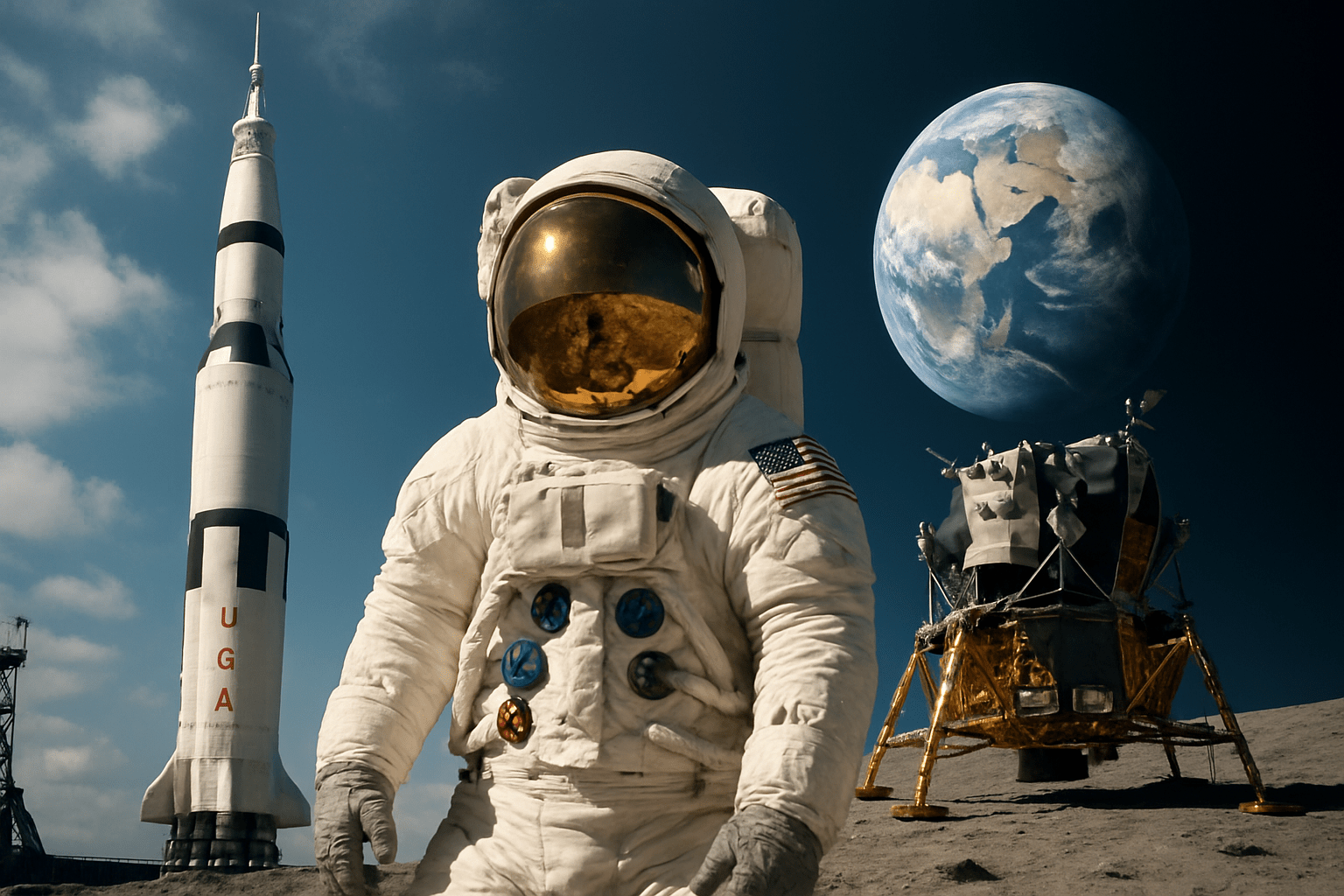
NASA mixes big engineering bets, long scientific programs and open data in ways few institutions do. This concise guide explains where NASA came from, which missions changed how we see the solar system and universe, the real technical lessons that recur, and practical steps for anyone who wants to use or follow NASA resources effectively.
Where NASA started and what it actually does
Born from a reorganisation of aeronautics research into a civil space agency, NASA is not a single-purpose lab. It funds and flies spacecraft, builds telescopes, backs university science, fosters commercial partners and shares massive public datasets. Its activity concentrates around human exploration, planetary science, astrophysics, Earth observation and aeronautics — but the work is best understood as a diversified portfolio rather than one homogeneous mission.
Milestones that set the patterns
Certain programs established rules of the road. Early crewed programs proved rendezvous and orbital operations. The Moon effort showed how political focus, huge resources and tight schedules can deliver an audacious engineering result. Later, reusable spacecraft taught a different lesson: operational complexity and hidden lifecycle costs matter as much as upfront engineering. Over time the highest science return has shifted toward long-lived robotic probes and precise space telescopes that operate above the atmosphere.
Robotic missions and why they punch above their weight
Robotic missions consistently deliver major discoveries with lower human-risk exposure. Examples are abundant: probes that mapped planetary surfaces, sample-return missions that collected primitive material, and telescopes that rewrote astrophysics textbooks. Strengths of robotic missions include long timelines, community-built instruments, and the ability to fuse datasets from different missions to ask new questions. Simple micro-example: combining orbital spectroscopy from one mission with ground-based lab spectra can resolve a mineralogical debate without sending people.
Human spaceflight has different trade-offs now
Human missions remain expensive and complex. The architecture has shifted toward a public–private mix: commercial firms provide crew and cargo services to low Earth orbit, while NASA directs efforts toward deep-space systems — habitats, life support, entry/descent and surface logistics. That model lowers NASA’s capital exposure but increases the need for tight interface control, well-aligned incentives and rigorous system-level testing.
What routinely breaks—and what that teaches us
Spaceflight exposes narrow margins. Common failure modes include thermal-protection breaches on re-entry or descent, hardware damage from ascent debris, and software errors that only surface under mission timing. Historical examples are blunt teachers: a units mismatch on a Mars mission cost the spacecraft; launch debris damaged thermal protection on a return vehicle; schedule pressure and normalized deviance contributed to catastrophic outcomes. The recurring fixes are organisational as much as technical: independent safety reviews, truthful test campaigns, and conservative design margins that buy time for diagnosis and recovery.
How NASA manages risk in practice
Risk control mixes engineering discipline and program governance. Critical systems receive independent verification and validation. Redundancy is designed where lives are at stake. Flight‑readiness reviews gate major leaps. For planetary missions, teams build safe states and contingency modes so ground operators can stabilise a probe before attempting complex recovery steps. When incidents occur, public investigation reports become learning materials for the whole community.
Partnerships, international collaboration and commercialisation
NASA rarely goes it alone. International modules, shared instruments and commercial launch services spread cost and expertise. That makes programs more resilient — a single supplier failure won’t always end a campaign — but brings friction: alignment of schedules, interface standards, export-control constraints and trust in safety processes. Success is usually practical: clear interface definition, frequent integration tests, and contractual incentives that tie payments to demonstrable milestones.
Open data, tools and where to find them
Open data is one of NASA’s biggest, most practical legacies. Useful entry points include the NASA Open API portal (api.nasa.gov), the NASA Image and Video Library (images.nasa.gov), the Planetary Data System (pds.nasa.gov) for mission archives, Earthdata for remote-sensing datasets, and the NASA GitHub organisation for code and tools. Major telescope data live in community archives; mission pages host technical reports and instrument papers.
Practical tips: register for an API key (there’s a DEMO key for quick tests), respect rate limits and cache results locally to reduce repeated queries. When you cite images or data, point readers to the primary mission page or peer‑reviewed reports. Most NASA-produced imagery is public domain, but check partner rules and mission-specific license notes before commercial reuse.
How to follow missions and extract value
For real-time events, NASA TV and mission livestreams are the authoritative sources. Mission pages provide status, anomaly reports and technical papers. If you build products with NASA data: use raw telemetry or calibrated science products where possible; store copies and metadata; and link back to the data DOI or mission archive. Students and educators can plug into challenge programs and citizen-science platforms that expose real datasets and curated tasks.
Why NASA matters outside rockets
Beyond exploration, NASA’s technologies and data seed improvements in aviation, climate science, medical devices, materials and autonomy. The agency acts as an incubator for high-risk, long-horizon projects that few commercial players can afford. That creates spillovers: algorithms for satellite remote sensing become environmental monitoring tools; autonomy developed for rovers improves industrial robotics.
Short practical checklist before you start a NASA-based project
- Identify the primary dataset or instrument and find its archive (PDS, Earthdata, MAST, etc.).
- Register for required API keys and read rate-limit policies; use exponential backoff on failed requests.
- Cache frequently used data and keep provenance metadata with each file.
- Cite mission pages or technical reports, not secondary summaries; verify licensing for third‑party content.
- Follow official mission pages for timeline and anomaly updates rather than relying on social posts.
Closing note
NASA is equal parts engineering shop, scientific manager and public archive. It still takes big risks, but the institutional memory—open reports, public data, and repeated lessons from failures—makes the next mission measurably safer and more productive. If you want to learn, build or teach with NASA material, start at the archives, plan for conservative margins and expect long timelines that reward patience and careful systems thinking.
Често задавани въпроси
Can anyone use NASA data? Yes. Many datasets and images are public; some require accounts or follow specific licensing notes. Always check the originating mission page.
Where do I get telemetry or image APIs? The NASA Open API hub (api.nasa.gov) is the usual starting point; mission archives like PDS and Earthdata host science datasets and higher‑volume telemetry.
Are NASA images free for reuse? Most NASA-created images are public domain, but partner contributions or third‑party content may require attribution or have restrictions—verify on the image page.
How does NASA handle mission failures? Investigations are performed publicly when appropriate, producing technical reports and corrective actions that other teams use to avoid repeat mistakes.
Should I trust social updates about a mission’s status? Use official mission pages, press releases and NASA TV for authoritative status; social channels are useful but secondary.
How can educators and students get involved? Look for NASA education programs, challenge competitions and citizen-science projects that provide curated datasets and teaching materials.
Статията е предназначена за…
This article is for engineers, science communicators, educators, students, data developers and space-curious readers who need a compact, practical briefing on NASA’s evolution, landmark missions, recurring technical lessons and how to access the agency’s public resources.
Полезни практики
- Use api.nasa.gov with your own key; switch from DEMO_KEY once experiments scale to avoid throttling.
- Cache API responses and store provenance (mission name, instrument, product ID) alongside raw files.
- When citing results, link to primary mission pages, PDS entries or peer-reviewed papers rather than news summaries.
- Check image licensing on the asset page—default to attribution even for public-domain media to preserve provenance.
- For integration work, demand interface tests and end‑to‑end rehearsals from partners; avoid accepting incremental deviations as ‘normal’.
- Follow mission livestreams and official anomaly reports for accurate timelines; treat social posts as pointers, not confirmations.
